
Battery Equalizer 48V
4.3Editor score
Works with 24V to 96V
5A compensation current active
Smart indicator lights included
This guide compares the top 12V 24V 48V Battery Equilizer Balancer models for reliable voltage balance and extended battery life in diverse power systems.
Finding the right battery balancer ensures your series-connected batteries stay balanced and last longer. A quality unit monitors voltage differences and equalizes charge automatically, preventing premature wear.
We evaluated ten top-rated balancers based on compatibility, safety features, and balancing current. Our analysis covers active and passive models suitable for lead-acid, lithium, and gel battery types.
Each pick highlights specific strengths like display clarity, port count, and protection mechanisms. Prices and availability change frequently, so verify current listings before making your final purchasing decision today.
4.3Editor score

4.3Editor score

4.1Editor score
The following table provides a side-by-side comparison of key specifications across all ten selected battery equalizers to help you identify the best match for your system.



The LiTime 48V Battery Balancer earns its top spot by offering robust active balancing for complex battery banks. With a 4.3 rating, it stands out for its 10A current and support for voltages up to 48V.
We may earn a commission when you buy through this link, at no additional cost to you.
Its active protection functions include reverse polarity and high temperature safeguards, ensuring safe operation even during accidental wiring errors. The device automatically detects voltage differences and switches to standby mode when balanced, conserving energy effectively.
While the 48V limit may not suit every industrial setup, the flexibility to use it on 24V and 36V systems makes it versatile for most RV and off-grid needs. The insurance coverage adds a layer of trust for long-term use.
If you need a reliable balancer for lead-acid or lithium batteries in a series configuration, this model delivers excellent performance and peace of mind for daily operation.
This balancer automatically equalizes voltage across connected batteries up to a 10mV difference, ensuring all cells work efficiently together without manual intervention.
It works with LiFePO4, lithium-ion, lead-acid, and GEL types, making it a universal solution for various energy storage projects.
We may earn a commission when you buy through this link, at no additional cost to you.
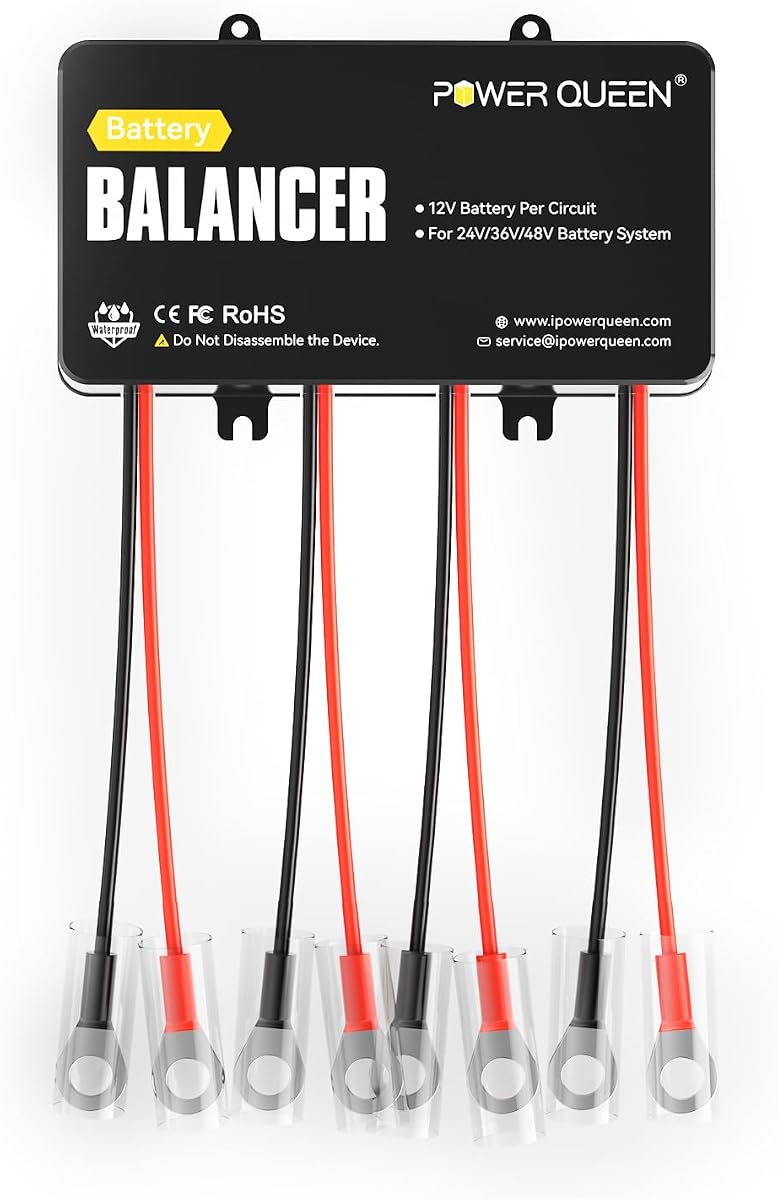
The Power Queen 48V balancer offers impressive performance with active balancing capabilities suitable for large RV systems. Its 4.3 rating reflects reliable operation and strong safety features that prevent battery damage.
We may earn a commission when you buy through this link, at no additional cost to you.
This device automatically starts working when voltage differences exceed 10mV, balancing until stable. The low-power standby mode ensures it does not drain your battery bank when not needed, extending overall system efficiency.
A minor trade-off is the need for careful wiring, especially for series-parallel setups. However, following the provided guidelines ensures optimal safety and longevity for your connected batteries.
For users needing a dependable solution for LiFePO4 or lead-acid batteries in 48V configurations, this balancer provides consistent results and essential protection features.
The unit detects imbalance quickly and engages balancing current immediately, preventing deep discharge in weaker cells during charging cycles.
High-temperature protection safeguards the balancer from overheating, ensuring reliable operation even in hot vehicle engine bays.
We may earn a commission when you buy through this link, at no additional cost to you.
Victron Energy is known for quality marine and off-grid equipment, and this balancer maintains that reputation with solid voltage equalization. It is designed to manage two series-connected 12V batteries efficiently.
We may earn a commission when you buy through this link, at no additional cost to you.
The unit turns on when charge voltage exceeds 27V, comparing and balancing voltage levels. Multiple units can be paralleled for higher systems, allowing flexible scaling for larger setups.
The 1A current might be slower than other models, but it ensures safety for sensitive battery chemistries. It requires more units for 48V systems, which could increase initial cost.
Marine and serious off-grid enthusiasts who prioritize durability and precise voltage control will appreciate this professional-grade battery balancing solution.
It eliminates load imbalance effects to ensure your battery bank converges to the same state of charge effectively.
You can connect several balancers in parallel to handle higher voltage banks while maintaining precise control over each cell string.
We may earn a commission when you buy through this link, at no additional cost to you.
This affordable balancer offers broad voltage coverage, making it suitable for large battery banks in trucks and boats. Its 4.5 rating suggests strong satisfaction among users looking for versatile balancing.
We may earn a commission when you buy through this link, at no additional cost to you.
The rail-type buckle installation simplifies mounting in distribution boxes, keeping cables organized. It handles various battery chemistries, including lithium and nickel-cadmium, ensuring flexibility for custom packs.
While specific current specs are absent, users report effective maintenance of charge balance over time. The lack of a dedicated standby mode may lead to slight energy draw when balanced.
Budget-conscious buyers with complex battery setups will find this unit offers excellent value and robust performance for everyday voltage maintenance needs.
The design allows for easy module installation in distribution boxes, simplifying cable management in tight spaces.
It supports a broad range of battery chemistries, including lead-acid, lithium, and nickel variants, for maximum adaptability.
We may earn a commission when you buy through this link, at no additional cost to you.
This unit provides visual feedback via an LED display, helping users track battery status in real time. While the rating is lower, it offers essential protection features for maintaining battery health.
We may earn a commission when you buy through this link, at no additional cost to you.
The reverse polarity protection and low voltage disconnect prevent damage from accidental mistakes or deep discharge. It connects default to four 12V batteries, simplifying setup for many users.
The lower rating may reflect user feedback on usability, but the core functionality remains solid for basic balancing needs. Ensure proper wiring to maximize its protective features.
For those wanting visual confirmation of their battery system's status while balancing, this model offers a practical and accessible solution.
The LED display allows users to quickly check battery status and ensure the system remains within safe operating parameters.
Low voltage disconnect protects batteries from excessive discharge, extending their service life in critical applications.
We may earn a commission when you buy through this link, at no additional cost to you.
Redodo delivers a robust solution with a high current rating that quickly addresses voltage discrepancies. Its 4.4 rating highlights user satisfaction with its reliability and clear LED display.
We may earn a commission when you buy through this link, at no additional cost to you.
The 1-year warranty and professional support provide confidence for buyers needing dependable service. It features M8 OT terminals and 50CM cables, making it easy to install directly into battery series systems.
While it supports 24V configurations, the current capability ensures rapid equalization. It may not scale to higher voltages without additional units, but it is perfect for standard setups.
Users looking for a straightforward warranty-backed option for 24V LiFePO4 or lead-acid systems will appreciate its performance and included support.
The 10A current allows the unit to reduce pressure difference between series batteries quickly, restoring balance faster.
Pre-attached cables and robust terminals simplify physical installation without requiring extra adapters or tools.
We may earn a commission when you buy through this link, at no additional cost to you.
This model from Power Queen is a reliable workhorse for 48V systems, offering consistent active balancing. Its 4.1 rating indicates solid performance for maintaining equalized charge across your battery bank.
We may earn a commission when you buy through this link, at no additional cost to you.
The high-temperature protection and automatic standby mode ensure it handles heat well and conserves energy when not actively balancing. It works with LiFePO4 and lead-acid, covering most user needs.
Though its rating is slightly lower than other Power Queen products, the core features remain effective. It requires attention to wiring to avoid errors in complex series-parallel systems.
For consistent voltage maintenance in off-grid or marine setups, this model provides dependable performance and essential safety mechanisms.
Users report stable operation over time, keeping battery strings at consistent charge levels to prevent premature failure.
The device switches to a low-power mode once balanced, minimizing energy waste during periods of system stability.
We may earn a commission when you buy through this link, at no additional cost to you.
This simple balancer uses indicator lights to show status, making it user-friendly for those who prefer visual cues. Its 4.3 rating suggests effective balancing for small to mid-sized battery systems.
We may earn a commission when you buy through this link, at no additional cost to you.
With a 5A compensation current, it handles standard loads efficiently. The smart lights provide immediate feedback on operation, and reverse polarity protection keeps your system safe from common mistakes.
The lower current means it may take longer to balance larger banks, but for smaller setups, it is sufficient. The lack of a display makes it less feature-rich than competitors.
If you need a straightforward, no-frills option with clear status indicators, this unit is a reliable and economical choice.
Indicator lights give you clear visibility of whether the unit is actively balancing or idle at any moment.
The low-voltage cutoff function safeguards battery health by preventing excessive discharge in unstable conditions.
We may earn a commission when you buy through this link, at no additional cost to you.
This model features a convenient LED display for checking voltage levels directly, simplifying system monitoring. Its 4.3 rating reflects stability and ease of use for various battery configurations.
We may earn a commission when you buy through this link, at no additional cost to you.
The flame retardant shell ensures safety in high-heat environments, and it supports both lead-acid and lithium types. The wire connections are straightforward, with a white wire for the middle point.
While the 5A current is moderate, it is adequate for most common setups. The digital display adds a layer of convenience not found in basic indicator models.
For those wanting a quick digital readout of their battery status while balancing, this unit delivers clear results and reliable operation.
The LED digital display allows for easy and convenient checking of product voltage and balance status.
The flame retardant shell offers improved safety for installation in confined or high-heat areas like engine bays.
We may earn a commission when you buy through this link, at no additional cost to you.
The MAZAVA HX02 is a premium unit offering precise voltage monitoring with an LCD display and aluminum shell for heat dissipation. It supports parallel modules for higher capacity systems, fitting professional needs.
We may earn a commission when you buy through this link, at no additional cost to you.
Its precision ensures tiny voltage differences are corrected quickly, protecting sensitive batteries from long-term imbalance. The aluminum shell improves durability and thermal management in demanding environments.
The higher cost may be a barrier for casual users, but the advanced features justify it for complex systems. It is designed for those prioritizing top-tier control and monitoring.
If you need professional-level precision and monitoring for your battery bank, this premium balancer offers the most advanced features available.
The voltage difference is measured in thousandths, enabling fast and precise equalization to maintain optimal battery health.
The aluminum alloy shell improves heat dissipation, ensuring reliable operation even under heavy or continuous loads.
We may earn a commission when you buy through this link, at no additional cost to you.
Choosing the right balancer depends on your system's voltage, battery chemistry, and required safety features. This guide explains key factors to help you select the best model.
Ensure the balancer supports your total bank voltage, such as 24V, 36V, or 48V. Some units require multiple balancers for higher setups like 96V.
Match the voltage rating to your system to prevent failure and ensure effective equalization across all cells.
Check if the unit supports your specific battery type, such as LiFePO4, Lead Acid, or GEL. Compatibility ensures safe and efficient balancing for your unique chemistry.
Always verify the supported range and type in the product data before purchasing to avoid damage.
Higher current ratings like 10A allow faster equalization compared to 1A models. Faster balancing helps maintain consistent performance during short charging cycles.
Select a current rating that matches your bank size and how quickly you need voltage levels to stabilize.
Look for reverse polarity protection, high-temperature protection, and low-voltage disconnects. These safeguards prevent accidental damage and extend the lifespan of your batteries.
Prioritize units with multiple protection layers to ensure your battery system remains safe in real-world conditions.
Models with LCD or LED displays provide real-time voltage data, helping you track balance progress easily. Visual indicators make it simpler to spot issues before they become critical.
Choose a display type that fits your monitoring preferences for better system visibility.
Rail-type buckles and pre-attached cables simplify installation in tight spaces like engine bays. Simple wiring reduces the risk of errors during setup.
Look for clear instructions and convenient mounting options to save time and effort.
Balancers with auto standby modes draw minimal power once balanced, saving battery energy. Low power draw is critical for systems that run for long periods without charging.
Verify the standby power consumption to avoid unnecessary drain on your battery bank.
A good warranty and accessible technical support give you peace of mind for long-term use. Professional support helps resolve any issues quickly after installation.
Check the warranty duration and support options before buying to ensure product reliability.
First, verify that your battery bank voltage matches the balancer rating. Incorrect voltage may cause damage to the unit or batteries. Always read the manufacturer manual before installing.
Connect the balancer according to the wiring diagram, usually with negative, positive, and middle leads. Ensure reverse polarity protection is respected to prevent short circuits.
Monitor the balancer occasionally to ensure it is working properly. Clean the unit to prevent dust buildup and check cables for wear.
A battery balancer ensures all connected series batteries reach the same state of charge. This prevents uneven wear and extends the life of your battery bank by avoiding overcharging or deep discharge of individual cells.
Yes, especially for series-connected lithium or lead-acid batteries. Balancers maintain cell balance and safety. Without one, uneven charging can lead to reduced capacity or system failure.
Check it monthly or after every major charging cycle. Look for indicator lights or display readings to confirm active balancing. Ensure connections remain tight and free of corrosion.
No, you must use a unit rated for your system voltage. Using a 24V unit on a 48V system will fail to protect cells. Check the maximum voltage supported by the model.
Active balancers move energy between cells to equalize them efficiently. Passive ones usually dissipate excess energy as heat. Active methods are faster and better for maintaining full charge.
Many units switch to standby mode when the voltage difference drops below a threshold like 10mV. This is normal and saves energy. It resumes when imbalance is detected again.
Yes, if it explicitly supports LiFePO4 or lithium-ion. These chemistries require precise control to avoid hazards. Always verify battery compatibility before installation.
Use rail-type mounts or secure the unit to a stable surface. Connect the leads to the correct terminals and ensure no wires touch metal surfaces. Test the system after wiring.
The LiTime and Power Queen models stand out for their high current and broad support. These are excellent choices for most RV and off-grid systems requiring reliable performance.
Prioritize safety features like reverse polarity protection and temperature control. Ensure the unit matches your voltage and chemistry needs to avoid long-term issues with your battery bank.
Always check current listings and availability as prices and stock vary frequently. Verify the latest compatibility details before finalizing your purchase for your specific setup.