
Entina Tina2C
4.4Editor score
Starts in 8 minutes
3000+ model library
20+ creative DIY modules
This guide compares the top 3D printers for educational use, evaluating ease of use, safety, and learning features to help schools and parents choose the right
Selecting the right 3D printer for educational use involves balancing performance, safety, and ease of use. Schools and parents need reliable machines that inspire creativity without overwhelming students with complex maintenance or technical hurdles.
We have evaluated ten leading models based on their setup time, calibration features, safety certifications, and educational support. This list covers everything from compact mini printers for young kids to robust units for advanced high school STEM programs.
Each pick highlights specific strengths like auto-leveling, multi-color capability, or safety enclosures. Prices and availability change frequently, so always check the current listing before purchasing to ensure you get the best deal available today.
4.4Editor score

4.7Editor score

4.6Editor score
This side-by-side comparison highlights the key specifications and unique selling points of each printer to help you quickly identify the model that best fits your educational needs and budget.





The Bambu Lab A1 stands out as the top choice for educational environments due to its blend of speed, precision, and user-friendly automation. With a rating of 4.7, it has earned trust among users who need consistent results without constant tweaking. Its standout quality is the full-auto calibration system that eliminates the traditional hurdles of bed leveling and Z-offset adjustments.
We may earn a commission when you buy through this link, at no additional cost to you.
In detail, the A1 delivers blazing-fast printing with an acceleration of 10,000 mm/s² while maintaining exceptional accuracy. The active flow rate compensation ensures smooth prints by adjusting extrusion in real-time. For schools, the quiet motor noise canceling is a significant benefit, allowing the printer to run in a classroom without disrupting lessons. The simplified touchscreen interface makes it accessible for students of various skill levels.
Honest trade-offs include the requirement to purchase the AMS lite separately for multi-color printing, which adds to the cost. Additionally, while the price is competitive for the performance, it is higher than basic hobbyist models. These are acceptable because the time saved on calibration and the reliability of prints justify the investment for educational settings where failure rates can waste budget.
This printer is ideal for high schools, makerspaces, and serious STEM programs where reliability and speed are paramount. The seamless workflow from design to print encourages students to focus on creativity rather than troubleshooting. We recommend it as the best overall pick for educational use where consistent high-quality output is required.
Full-auto calibration handles Z-offset and bed-leveling automatically, ensuring optimal performance for every print without manual intervention.
Active motor noise canceling technology allows the printer to operate quietly, so it does not disturb students or teachers during class.
We may earn a commission when you buy through this link, at no additional cost to you.
The Entina Tina2C is designed specifically for first-time users and kids, offering a frictionless entry into 3D printing. With a solid rating of 4.4, it has proven to be a reliable companion for home and classroom STEM projects. Its standout quality is the guided setup process through the Poloprint Cloud app that allows students to start printing in as fast as eight minutes.
We may earn a commission when you buy through this link, at no additional cost to you.
Key strengths include the extensive library of over 3,000 models and 20 creative DIY modules that turn learning into an engaging experience. The intelligent auto-leveling and power-loss recovery features reduce the likelihood of failed prints, which is crucial for maintaining student enthusiasm. The flexible magnetic build plate makes it easy to remove prints without tools, simplifying maintenance for young users.
Trade-offs involve the compact print volume of roughly 3.9 inches, which limits the size of objects students can create in one go. It is also primarily optimized for PLA, which restricts engineering experiments with tougher materials. However, for introductory courses and small projects, these limitations are minor compared to the ease of use and affordability it offers.
This mini printer is perfect for elementary and middle school classrooms, home education, and small DIY hobbies. It bridges the gap between toy and tool, providing enough functionality to teach design principles without overwhelming complexity. We recommend it as the best budget option for educators looking to introduce 3D printing without a significant financial investment.
Fully optimized for beginners, the Tina2C allows users to start their first print in as fast as eight minutes with guided app setup.
The Poloprint Cloud app provides AI-powered search and STEM learning courses, turning creativity into an engaging educational experience.
We may earn a commission when you buy through this link, at no additional cost to you.
The Ugee Funbox is the premier choice for families and educators prioritizing safety and engagement. With a rating of 4.6, it has gained acclaim for its UL GREENGUARD Gold certification, ensuring low emissions and a safe environment for children. Its standout quality is the combination of a massive library of over 12,000 print-tested toys and AI-powered creation tools that simplify design.
We may earn a commission when you buy through this link, at no additional cost to you.
In detail, the Funbox offers zero calibration technology and a fully enclosed body with anti-pinch doors to protect little fingers. The integrated HD camera streams live progress and creates time-lapse videos, making the process shareable and educational. The AI engines can turn text, photos, or voice commands into printable models, removing the need for CAD skills and fostering immediate creativity.
Trade-offs include single-color printing only, which requires assembling parts to create multi-color toys. Some advanced features might require app subscriptions, which could add ongoing costs. However, the safety certifications and the sheer volume of engaging content make these minor issues acceptable for a machine designed to inspire long-term interest in STEM.
This printer is ideal for homes, schools, and creative spaces where safety and ease of use are non-negotiable. It transforms screen time into hands-on making, teaching design thinking and spatial reasoning through play. We recommend it as the best premium pick for those who want a top-tier educational tool that is both safe and incredibly engaging.
Certified to UL GREENGUARD Gold and CPSIA standards with anti-pinch features and HEPA filters ensuring a clean safe air environment.
Four AI engines transform text photos and voice into printable models instantly allowing kids to create without needing design skills.
We may earn a commission when you buy through this link, at no additional cost to you.
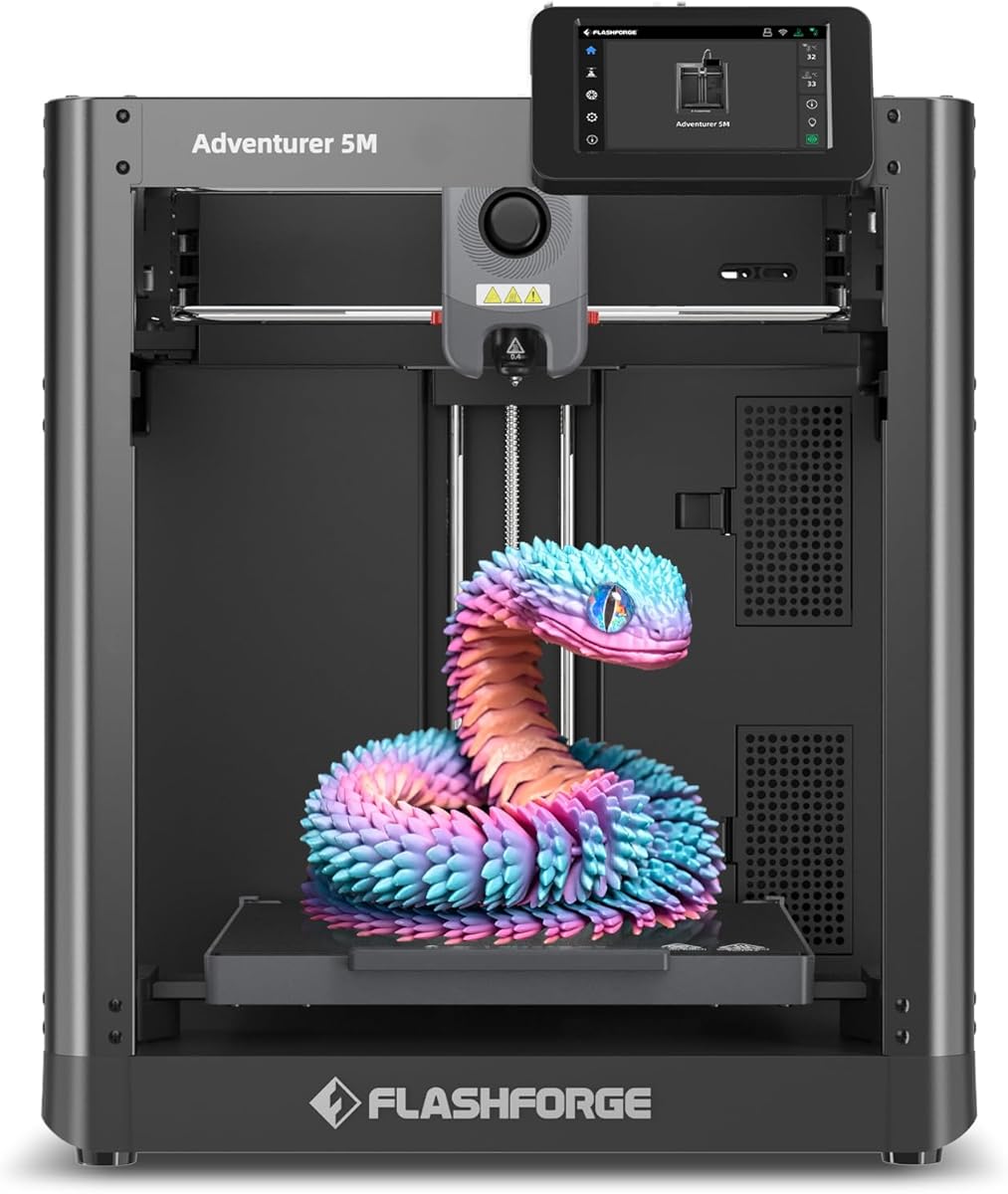
The FLASHFORGE Adventurer 5M is built for speed and efficiency, making it suitable for production-style educational projects. While it has a rating of 3.9, its high-speed features allow for rapid prototyping in design classes. Its standout quality is the CoreXY all metal structure and max speed of 600mm/s which significantly reduces print times for complex models.
We may earn a commission when you buy through this link, at no additional cost to you.
In detail, the printer features a high-flow 32mm³/s nozzle and a 3-second detachable nozzle system that simplifies maintenance. The dual-sided PEI platform offers versatile adhesion options, while the real-time app monitoring keeps users informed remotely. The vibration compensation helps maintain quality despite the high speeds, ensuring prints remain precise.
Trade-offs include a lower user rating compared to some competitors and potential noise levels at high-speed modes which might be distracting in quiet classrooms. The auto leveling is effective but can require occasional recalibration if the machine is moved frequently. However, the performance-to-price ratio remains attractive for institutions needing throughput.
This printer is best for high school tech labs and universities where speed is a priority for project deadlines. It offers a robust platform for students to explore high-speed manufacturing concepts. We recommend it for users who prioritize fast turnaround times and reliable performance over ultra-quiet operation.
Featuring a CoreXY structure with 600mm/s travel speed the printer maximizes efficiency and reduces production cycles.
Real-time app monitoring allows students and teachers to monitor print progress and adjust settings remotely anytime anywhere.
We may earn a commission when you buy through this link, at no additional cost to you.
The Bambu Lab P1S offers a robust enclosed design that improves performance for advanced filaments used in engineering education. With a rating of 4.5, it has established itself as a reliable tool for students who need to print stronger materials. Its standout quality is the enclosed body combined with full auto calibration which ensures success with sensitive materials like ABS and ASA.
We may earn a commission when you buy through this link, at no additional cost to you.
In detail, the printer supports 500mm/s speeds and acceleration of 20,000 mm/s² ensuring rapid creation of parts. The setup takes only about 15 minutes which minimizes downtime and gets students printing quickly. It accepts a wide range of filaments including PLA PETG and PVA making it versatile for various curriculum needs.
Trade-offs include the need to buy the AMS separately for multi-color printing and the lack of a built-in camera for monitoring. The enclosed design helps with airflow but might require a filter system in tightly sealed rooms. Despite these, the reliability and material versatility make it a strong choice for advanced educational applications.
This printer is ideal for advanced high school STEM programs and college makerspaces where material variety is important. It provides a professional-grade experience at an accessible price point. We recommend it for educators needing a machine that can handle diverse engineering tasks without constant maintenance.
Fully enclosed body improves print performance for advanced filaments by maintaining consistent temperature throughout the print.
Spend more time printing and less time setting up with a user-friendly design ensuring a hassle-free assembly experience.
We may earn a commission when you buy through this link, at no additional cost to you.
The FLASHFORGE AD5M is a powerful printer designed for both beginners and experts. With a rating of 4.3 it is recognized for its durability and ease of maintenance. Its standout quality is the patent quick-release nozzle and fully automatic one-click leveling system that makes calibration virtually effortless for students.
We may earn a commission when you buy through this link, at no additional cost to you.
In detail, the CoreXY all-metal motion structure ensures stable smooth low-noise performance even at high speeds. The enhanced control includes Orca-flashforge slicer support for batch file transmission and the Flash Maker APP for remote monitoring. The reverse PEI plate design is specifically adapted for PETG providing versatile printing options.
Trade-offs include a smaller ecosystem compared to larger brands and a standard build volume that is slightly limiting for very large projects. The software is functional but may require some familiarization for advanced users. However the simplicity and reliability of the hardware make it a great choice for general educational use.
This printer is best for school labs needing a robust machine that requires minimal intervention. It is easy to maintain and forgiving for new users. We recommend it for institutions looking for a reliable workhorse that balances speed and quality well.
Equipped with fully automatic one-click leveling system ensures a flawless first layer every time without manual tools.
The tool-free nozzle can be swapped in as little as 3 seconds simplifying maintenance for novices and experts alike.
We may earn a commission when you buy through this link, at no additional cost to you.
The Bambu Lab P2S Combo is a premium solution for schools requiring multi-color capabilities. With a rating of 4.7 it excels in speed and precision. Its standout quality is the inclusion of the AMS 2 Pro which enables seamless multi-color printing while maintaining sharp corners and consistent results.
We may earn a commission when you buy through this link, at no additional cost to you.
In detail, the printer prints up to 600 mm/s and includes built-in filament drying to keep spools ready for flawless prints. The adaptive airflow system automatically balances cooling and heat retention to suit various materials. It sets up in about 15 minutes and features AI failure detection to reduce downtime.
Trade-offs include a significantly higher price and a larger physical footprint that may strain classroom space. The complex features might be overkill for simple projects but the productivity gains justify it for larger programs. However the ease of use makes even advanced workflows accessible to students.
This printer is ideal for universities and specialized design labs where multi-material prototyping is necessary. It brings professional-grade capabilities to educational settings. We recommend it for programs where budget allows for top-tier performance and color versatility.
The AMS 2 Pro enables seamless multi-color and multi-material 3D printing with built-in filament drying capabilities.
Adaptive airflow system automatically balances cooling and heat retention keeping overhangs crisp and maintaining chamber temperature.
We may earn a commission when you buy through this link, at no additional cost to you.
The FLASHFORGE Adventurer 5M V2 is an upgraded version offering high-speed reliability for students. With a rating of 4.3 it is known for consistent performance and quick setup. Its standout quality is the upgraded direct extruder with vibration compensation which eliminates ghosting and ensures smooth prints at 600mm/s.
We may earn a commission when you buy through this link, at no additional cost to you.
In detail, the printer reaches 200°C in just 35 seconds and has a robust design suitable for well-ventilated environments. The filament run-out sensor and power loss recovery eliminate common failure points allowing students to focus on learning rather than fixing. The flexible removable PEI steel plate supports various filaments like PLA and PETG.
Trade-offs include the open design which requires good ventilation and may not be suitable for rooms with strict air safety standards. The build volume is standard which limits very large projects. However the speed and reliability make it a practical choice for general education.
This printer is best for schools needing a fast and reliable machine that is easy to maintain. It is ideal for introductory to intermediate levels of 3D printing. We recommend it for educators looking for quality performance without a complex enclosed system.
From unboxing to starting printing it takes only 10 minutes allowing happy printing every day and great all-around quality.
Filament run-out sensor and power loss recovery eliminate problems with empty spools or power cuts during critical prints.
We may earn a commission when you buy through this link, at no additional cost to you.
The Snapmaker U1 offers a unique multi-toolhead system that simplifies multi-color printing. With a rating of 4.5 it is praised for its engineering and reliability. Its standout quality is the 5-second tool changer which reduces waste and time compared to traditional filament swapping methods.
We may earn a commission when you buy through this link, at no additional cost to you.
In detail, the printer features independent toolheads that switch between rigid flexible and soluble supports automatically. It supports true multi-material printing allowing for complex prototypes in a single job. The smart calibration and automatic toolhead offset calibration ensure smooth and accurate results with minimal manual adjustment.
Trade-offs include the high initial cost and the complexity of managing multiple toolheads. The system is more advanced which may require time for teachers to learn fully. However the waste reduction and flexibility make it a powerful tool for advanced design classes.
This printer is ideal for universities and professional training centers where advanced prototyping is taught. It provides capabilities similar to industrial machines. We recommend it for programs willing to invest in a high-end tool for complex project work.
Four independent toolheads enable true multi-color printing without manual filament swaps or purging reducing waste significantly.
Combine rigid and flexible materials water-soluble supports and engineering materials in a single print for greater design freedom.
We may earn a commission when you buy through this link, at no additional cost to you.
The Bambu Lab A1 Mini Combo brings full A1 features to a smaller footprint. With a rating of 4.2 it is a solid choice for limited spaces. Its standout quality is the combination of full auto calibration and the AMS lite multi-color capability in a compact form factor.
We may earn a commission when you buy through this link, at no additional cost to you.
In detail, the setup takes just 20 minutes and the printer maintains the same fast acceleration as the larger A1. The active noise cancellation keeps levels below 48 dB making it suitable for quiet environments. The simplified touchscreen and quick swap nozzle make it easy for students to maintain.
Trade-offs include a smaller build volume which restricts large parts and slightly less rigidity than the full A1. However the cost savings and space efficiency make it a great entry-level option. The multi-color support adds fun and versatility for younger students.
This printer is ideal for elementary classrooms home setups and small makerspaces needing multi-color functionality without large size. It bridges the gap between toy and professional grade. We recommend it for educators needing a compact reliable multi-color printer.
A1 mini offers same blazing-fast printing acceleration as full A1 with compact footprint for small workspaces.
Bambu Lab A1 Mini 3D printers make multi-color printing accessible and reliable for everyone with AMS lite combo.
We may earn a commission when you buy through this link, at no additional cost to you.
Choosing the right 3D printer for education requires evaluating safety features, ease of use, and material compatibility to ensure a successful learning experience.
Look for printers with automatic bed leveling and calibration systems. Features like auto-leveling save valuable class time and reduce the frustration of failed first layers. When calibration is automated students can focus on design and creativity rather than troubleshooting mechanical issues.
Prioritize models with one-click setup and intuitive touchscreen interfaces. Simplified workflows ensure that teachers and students can get printing quickly without extensive training.
Safety is paramount in educational settings so consider enclosed printers for better containment of fumes and heat. Enclosed designs also help maintain stable temperatures for advanced filaments like ABS. Look for certifications like UL GREENGUARD Gold which indicate low emissions suitable for indoor environments.
Ensure the printer has physical safety features such as anti-pinch doors and cool-touch exteriors. These prevent accidents with children and maintain a safe classroom environment during operation.
Assess the build volume based on the projects your students will create. Compact printers are suitable for small models and limited desk space but might be too small for engineering parts. Consider the physical footprint and whether the printer fits in your classroom or lab area.
A balance between build size and portability is often best. Smaller printers are easier to move between classes but ensure the volume is sufficient for your curriculum goals.
High-speed printers allow more projects to be completed within a single class period. Look for models with fast travel speeds and acceleration to reduce wait times. Reliability is equally important to ensure that students do not face excessive failures that discourage learning.
Features like power-loss recovery and filament run-out sensors add reliability. These prevent wasted materials and time when unexpected interruptions occur during printing.
Some educational programs require printing with advanced materials like PETG or ABS while others only need PLA. Ensure the printer can handle the materials you plan to use. Higher temperature extruders and heated chambers expand the range of usable filaments significantly.
Versatility in materials allows for more complex projects and engineering applications. However for beginners sticking to PLA is often sufficient and safer.
Multi-color printing adds an extra dimension to student projects and increases engagement. Systems with automatic tool changers or multi-material systems make color switching seamless. This feature is especially appealing for younger students and visual design projects.
Check if multi-color features are included or require add-ons like AMS. The cost of accessories can affect the overall budget and value proposition of the printer.
Modern printers should offer robust software ecosystems including slicer support and mobile apps. Connectivity via WiFi allows remote monitoring which is useful for long prints. App control enables teachers to check progress without entering the classroom constantly.
Look for platforms with large model libraries or educational content. Access to pre-sliced models can accelerate learning and provide examples for students to study.
Educational printers will see heavy use so choose models with durable construction and easy maintenance features. Quick-swap nozzles and accessible parts reduce downtime when issues arise. Check the availability of replacement parts and customer support resources.
Warranty coverage is also critical to protect your investment. Reliable manufacturer support ensures you get help quickly when technical issues occur in a school setting.
Start by setting up the printer in a well-ventilated area away from foot traffic. Ensure it is placed on a stable surface to prevent vibrations from affecting print quality. Connect the power and establish a stable WiFi connection to enable remote monitoring features.
Begin with simple test prints using PLA filament to calibrate settings and get familiar with the software. Use auto-leveling features to ensure a perfect first layer before moving on to complex designs. Always keep spare nozzles and filament on hand to minimize downtime during class.
Regularly clean the build plate and check for filament jams to maintain consistent performance. Keep the software updated to access the latest features and security patches. Teach students to follow a shutdown routine to prevent accidental power cuts during active prints.
For elementary students, safety and simplicity are key. The Ugee Funbox is an excellent choice because it is UL certified safe and offers an intuitive interface with a massive library of toys. The Entina Tina2C is also great for its rapid setup and model library that keeps young learners engaged.
Yes, when you choose a model with proper safety certifications like UL GREENGUARD Gold. Enclosed designs prevent accidental burns and contain fumes. Always ensure the room has adequate ventilation and establish safety rules for students when they are near the printers.
3D printing enhances learning by turning abstract concepts into tangible objects. It teaches design thinking problem-solving and engineering principles in a hands-on way. Students gain technical skills while fostering creativity and innovation across various subjects.
Modern educational printers have reduced maintenance needs with features like auto-leveling and quick-swap nozzles. However regular cleaning and occasional calibration are still necessary. Schools should set aside time for basic checks to keep machines running smoothly.
Yes but it depends on print times. High-speed printers like the Adventurer 5M allow multiple jobs to be queued and completed faster. Using models with remote monitoring allows teachers to schedule prints and manage multiple users efficiently.
PLA is the best starting point because it is safe easy to print and biodegradable. It is suitable for most student projects. Advanced classes might explore PETG or TPU for durability and flexibility but these require more careful handling.
Choose closed designs if you plan to print with ABS or need a safer enclosed environment. Open designs are better for ventilation and access to components but are generally limited to PLA. Consider your classroom space and material needs before deciding.
Multi-color printing is not strictly necessary but it adds significant engagement value. It helps illustrate complex parts better and is great for visual learning. If budget allows, models with optional multi-color modules provide a richer learning experience.
We have reviewed ten top models ranging from budget-friendly mini printers to robust professional-grade units. The Bambu Lab A1 offers the best balance of speed and automation while the Entina Tina2C provides excellent value for young learners. For top safety and engagement the Ugee Funbox stands out as a premium choice.
When selecting a printer prioritize features like auto-calibration and safety certifications to minimize troubleshooting and risks. Consider the size of your classroom and the complexity of the projects you want to run to ensure the machine meets your needs.
Prices and availability for these printers change frequently so always verify the current listing before purchasing. Investing in a reliable machine will pay off in the quality of education and creative growth it provides to your students.