
HiLetgo ADS1115
4.3Editor score
16-bit resolution precision
I2C interface easy wiring
Programmable gain amplifier
This guide compares the top 10 Arduino ADC boards for precision sensing, data acquisition, and microcontroller projects to help you find the right module.
Arduino projects often require reading analog signals from sensors that exceed the built-in capabilities of standard microcontrollers. An external ADC board solves this by providing higher resolution and more channels for accurate data collection in your electronic designs.
We evaluated ten highly rated ADC modules based on resolution, channel count, communication interface, and compatibility with popular platforms like Arduino and Raspberry Pi. Each product offers unique strengths for different sensing tasks and budget requirements.
Every pick includes key specifications, pros and cons, and practical usage notes to help you decide which module fits your specific needs. Please note that prices and availability can change frequently so check current listings before ordering.
4.3Editor score

4.6Editor score

4.4Editor score
The following table provides a side-by-side comparison of all ten modules including their key specifications and features to help you quickly identify the best match for your project requirements and sensor types.




The HiLetgo ADS1256 stands out as a premium choice for users needing high precision data acquisition. With a 24-bit resolution and onboard reference voltage, it delivers exceptional accuracy for professional-grade sensor measurements.
We may earn a commission when you buy through this link, at no additional cost to you.
This module features eight single-ended channels that can be configured for differential inputs. The onboard voltage reference ensures consistent readings even when power supply fluctuates. The nonlinearity error is remarkably low for stable long-term monitoring.
One trade-off is the SPI interface which requires more pins than I2C. The price point is higher than basic modules but justified for precision applications where signal integrity is critical and noise must be minimized.
Buy this if you need 24-bit precision and multiple channels for industrial monitoring or high-fidelity sensor logging. It is ideal for projects demanding stable reference voltages and accurate differential signal processing capabilities.
The 24-bit resolution allows detection of minute voltage changes ensuring your data acquisition system captures subtle sensor variations accurately without rounding errors or signal loss.
The integrated voltage reference chip provides a stable 2.5V datum which improves measurement accuracy by compensating for supply voltage fluctuations during extended operation periods.
We may earn a commission when you buy through this link, at no additional cost to you.
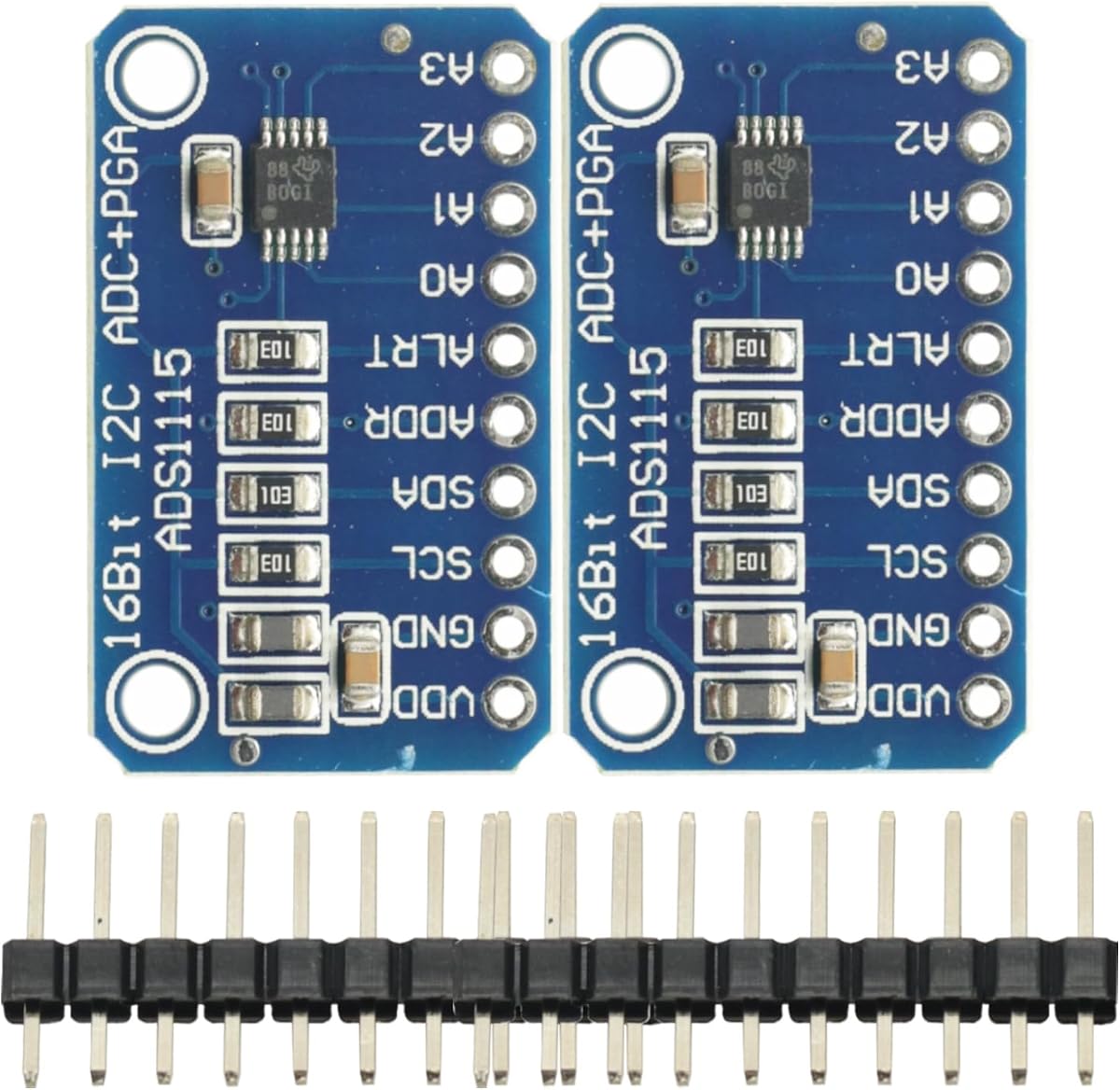
The HiLetgo ADS1115 offers excellent value for budget-conscious makers needing reliable analog-to-digital conversion. Its I2C interface simplifies wiring while the programmable gain amplifier helps boost small signals for better sensitivity.
We may earn a commission when you buy through this link, at no additional cost to you.
This module supports four input channels and operates across a wide voltage range making it versatile for various sensors. It integrates well with Arduino and Raspberry Pi boards providing stable readings for temperature or voltage monitoring tasks.
While it lacks 24-bit resolution and an onboard reference voltage it performs admirably for most hobbyist and classroom applications. The savings allow you to scale up your sensor network without breaking your project budget.
Buy this if you need an affordable I2C ADC for standard sensing tasks. It is perfect for beginners or large deployments where cost efficiency and simplicity outweigh the need for industrial-grade precision.
The built-in PGA amplifies small signals improving resolution for low-voltage sensors like thermocouples without requiring external amplification circuitry on your prototype board.
Support for 2.0V to 5.5V supply means it works with both 3.3V and 5V microcontrollers allowing flexible integration into different hardware platforms easily.
We may earn a commission when you buy through this link, at no additional cost to you.
The Lonely Binary 3-Pack combines high build quality with premium features like ENIG gold plating for oxidation resistance. It provides reliable solderability and long-term durability for demanding environments or repeated use.
We may earn a commission when you buy through this link, at no additional cost to you.
With four selectable I2C addresses you can chain up to four modules for sixteen total channels on one bus. The kit includes pre-soldered headers and supports various languages making it versatile for advanced IoT projects.
While resolution remains at 16-bit the build quality and multi-module support justify the premium positioning. The three-pack is ideal for classrooms or labs needing spares and consistency across multiple nodes.
Buy this if you value reliability and multi-channel scalability in a premium package. It suits professional deployments and educational settings where durable components and flexible library support are essential priorities.
The gold plated connectors prevent oxidation over time ensuring consistent electrical contact and reliable soldering even in humid or corrosive environmental conditions.
Four selectable I2C addresses allow you to connect multiple modules on the same bus expanding your channel capacity without consuming additional microcontroller pins unnecessarily.
We may earn a commission when you buy through this link, at no additional cost to you.
The Teyleten Robot ADS1115 comes in a three-pack offering great value for multi-node setups. Its high user rating reflects consistent performance and ease of integration across various sensor networks and data logging systems.
We may earn a commission when you buy through this link, at no additional cost to you.
Features include an internal programmable gain amplifier and a single-shot mode that auto shuts down to save power. The I2C interface keeps wiring simple while the module handles voltage ranges suitable for most microcontrollers.
While it shares standard limitations with other ADS1115 modules the three-pack format is practical for expanding your projects. It strikes a balance between cost performance and features suitable for general purpose hobbyist applications.
Buy this if you need multiple reliable ADC modules for distributed sensing or IoT projects. The three-pack ensures you have spares and the high rating indicates dependable quality for long-term use.
Getting three modules in one package reduces cost per unit and provides spares for multiple projects ensuring you never run out while prototyping complex sensor arrays.
The auto shut down single-shot mode conserves power when not actively sampling making it ideal for battery operated devices needing extended run times without constant voltage drain.
We may earn a commission when you buy through this link, at no additional cost to you.
The 2Pcs ADS1115 bundle achieves a perfect user rating reflecting high satisfaction with its performance and reliability. It offers flexible data rates and input ranges suitable for diverse sensor signal conditions and voltage levels.
We may earn a commission when you buy through this link, at no additional cost to you.
With seven programmable input ranges you can measure signals from microvolts to several volts with precision. The two-pack allows you to build a redundant system or share with collaborators while maintaining consistent specs.
Its limitations include standard ADS1115 capabilities but the perfect rating suggests it excels in real-world usability. The data rate flexibility helps optimize sampling frequency for power consumption or speed needs.
Buy this if you want a proven performer with flexible input options. The perfect rating and two-pack format make it a safe choice for reliable multi-channel projects with varied signal requirements.
Program the data rate from 8 to 860 samples per second to balance speed and power usage based on your specific application needs and sensor response times.
Select from seven input voltage ranges to match your sensor output levels ensuring maximum resolution without risking input signal clipping or measurement error.
We may earn a commission when you buy through this link, at no additional cost to you.
The HiLetgo 3pcs ADS1115 bundle provides three modules for scalable projects at a reasonable price point. Its comparator mode is a distinct feature useful for threshold-based alarms without constant microcontroller polling.
We may earn a commission when you buy through this link, at no additional cost to you.
Each module includes a programmable gain amplifier to boost weak signals and supports a wide voltage range. The I2C interface ensures easy integration with Arduino and Raspberry Pi boards for rapid prototyping.
While it shares the standard ADS1115 limitations the three-pack is practical for larger installations. The comparator mode adds functionality for basic monitoring tasks without needing software logic for every threshold check.
Buy this if you need multiple modules with comparator capabilities for threshold detection. It is well suited for automated monitoring systems where simplicity and cost-effectiveness matter most for sensor networks.
Operating in comparator mode allows the module to trigger alerts when a signal crosses a threshold reducing microcontroller load for simple alarm or safety monitoring applications.
The PGA adjusts gain internally improving sensitivity for low voltage sensors without requiring additional external amplifier components on your circuit board.
We may earn a commission when you buy through this link, at no additional cost to you.
The 4Pcs ADS1115 bundle offers a bulk four-pack solution ideal for large scale deployments or educational labs. Its internal oscillator removes the need for external crystals and the differential input support reduces common mode noise.
We may earn a commission when you buy through this link, at no additional cost to you.
Each module supports differential inputs allowing you to measure voltage differences directly which is crucial for accurate sensor readings in noisy environments. The I2C interface keeps wiring minimal and simple.
While the user rating is moderate the quantity and affordability make it attractive for scaling up. The bulk format ensures you have enough modules for comprehensive sensor arrays without significant cost.
Buy this if you need many modules for large projects or classrooms. The four-pack format and differential support provide practical value for expanding your sensing capabilities affordably and efficiently.
The built-in internal oscillator simplifies the circuit by removing external crystal components reducing parts count and assembly complexity for your prototype or final design.
Support for differential inputs helps reject common mode noise improving accuracy when measuring signals in electrically noisy environments or with long cable runs.
We may earn a commission when you buy through this link, at no additional cost to you.
The 2PCS ADS1115 bundle earns a perfect user rating indicating strong reliability and ease of use for makers. It offers seven input ranges and wide voltage support ensuring flexibility across many sensor types.
We may earn a commission when you buy through this link, at no additional cost to you.
With an onboard PGA you can adjust sensitivity to match low voltage sensors without external components. The two-pack format is convenient for building paired sensor systems or keeping a spare module ready.
Its constraints include standard 16-bit resolution but the perfect rating suggests it performs consistently well. The wide voltage range ensures it works with both 3.3V and 5V systems without logic level issues.
Buy this if you want a dependable two-pack with flexible input options. The perfect rating and wide voltage compatibility make it a safe and versatile choice for varied Arduino projects.
Operating from 2.0V to 5.5V ensures compatibility with both 3.3V and 5V logic levels allowing you to use it with diverse microcontrollers without voltage shifters.
Seven programmable input ranges allow you to tailor the ADC scale to your sensor output maximizing resolution and accuracy across different measurement applications.
We may earn a commission when you buy through this link, at no additional cost to you.
The Teyleten Robot AD7606 is designed for high speed applications requiring synchronous sampling across eight channels. It offers a 200KHz sampling rate and wide input range supporting differential signals up to ±10V.
We may earn a commission when you buy through this link, at no additional cost to you.
Parallel output options allow high throughput data transfer ideal for waveform analysis or real-time control. The internal reference and oversampling modes enhance measurement stability in professional or industrial environments.
However the lower user rating reflects the complexity of the interface and setup. It requires careful wiring and control logic making it better suited for experienced users than typical hobbyists.
Buy this if you need synchronized multi-channel sampling at high speeds. It is ideal for power electronics or vibration analysis where timing accuracy and channel alignment are more critical than ease of use.
All eight channels sample simultaneously ensuring precise phase alignment across signals which is critical for analyzing AC waveforms or vibration data accurately.
The 200KHz sampling rate enables capture of fast transient signals and high frequency phenomena ensuring no critical signal events are missed during acquisition.
We may earn a commission when you buy through this link, at no additional cost to you.
The 4PCS ADS1115 bundle provides high user satisfaction with its four pack format suitable for large sensor networks. It features a programmable gain amplifier and wide compatibility with popular microcontroller platforms.
We may earn a commission when you buy through this link, at no additional cost to you.
Each module offers four input channels and I2C interface for simple wiring. The PGA ensures you can handle small signal voltages effectively. The four pack allows expanding coverage across many measurement points.
Its standard 16-bit limitations are offset by the quantity and reliable performance. This makes it a practical solution for projects needing multiple ADC points without exceeding budget or complexity constraints.
Buy this if you need scalable multi-channel ADC capability. The four pack and high rating make it a reliable choice for expanding your sensing infrastructure across multiple monitoring locations.
Compatible with Arduino Raspberry Pi ESP32 and other platforms ensuring you can integrate these modules into existing setups without hardware or software hurdles.
The built-in PGA amplifies small signals improving resolution for low voltage sensors without needing external amplifier circuits on your prototype board.
We may earn a commission when you buy through this link, at no additional cost to you.
Selecting the right ADC board involves considering resolution, channels, interface, and power requirements. This guide breaks down the key factors to help you make an informed choice for your project.
Resolution determines the smallest voltage change the board can detect. 16-bit boards offer 65,536 steps suitable for most general sensing while 24-bit boards offer finer detail for high precision instruments.
Choose resolution based on your sensor's output range and the detail required in your final measurements to ensure data accuracy and meaningful signal processing.
Channel count dictates how many sensors you can connect directly. Single modules offer four or eight channels but multiple modules can be chained on the same bus to expand capacity.
Calculate the total number of inputs you need and select a board or bundle that supports expansion to avoid rewiring as your project grows.
Most boards use I2C for simple wiring with just two data pins while others use SPI for faster data rates. I2C is easier for beginners but SPI offers higher throughput for high-speed sampling.
Choose the interface that matches your microcontroller's available pins and the speed requirements of your application to optimize system performance and wiring complexity.
Check that the board accepts your sensor's output voltage. Some boards support ±10V while others require 0 to 3.3V or 5V ranges to ensure safe and accurate signal conversion.
Match the input range to your sensor specifications to avoid signal clipping or damage and use external dividers if necessary for wider signals.
Modules with onboard voltage references provide stable accuracy regardless of supply fluctuations. This is critical for precision measurements where supply noise could distort readings.
If your project demands high accuracy over time choose a board with an internal reference to maintain consistent calibration and reliable sensor readings.
For battery operated projects look for boards with low power modes or single-shot operation that allows the ADC to wake only when sampling is needed.
Minimize power usage by selecting a board with auto shut down features to extend battery life in remote or portable monitoring applications.
Quality soldering and durable connectors ensure long-term reliability. Look for boards with gold plating or robust traces especially for industrial or long deployment projects.
Invest in high build quality to reduce the risk of connection failures and ensure your sensors maintain stable readings over time without intermittent errors.
Good community libraries for Arduino or Python simplify integration. Check if drivers are available and well documented to speed up your development and debugging process.
Choose a board with active library support to save time on driver writing and ensure compatibility with the latest software updates and IDEs.
Connect power and ground first then data pins to your microcontroller's I2C or SPI bus. Ensure voltage levels match to prevent logic errors or hardware damage during operation.
Install the appropriate library for your board and test basic readings before integrating with your main code. Verify the address settings if chaining multiple modules on the same bus.
Keep the module clean and dry to prevent corrosion and ensure solder joints remain secure. Periodically check connections and recalibrate if your measurements drift due to temperature or component aging.
Yes most ADC boards support Raspberry Pi via I2C or SPI interfaces. The Pi lacks analog pins so external ADC modules are necessary for reading analog sensors accurately.
I2C uses two data wires and is simpler for low-speed applications while SPI uses more wires but offers higher data transfer rates and better noise immunity for high-speed sampling.
Use modules with configurable I2C addresses to allow multiple units on the same bus. Set the address pins on each board so they respond to different addresses without conflicts.
Noise often comes from poor power supply decoupling or long wires. Use a stable voltage source and keep signal wires short to minimize interference and improve signal quality.
Most modern ADC boards support 3.3V logic and supply. Always check the voltage range specs to ensure compatibility with your microcontroller's operating level.
A PGA amplifies the input signal before conversion allowing you to measure very small voltages with higher resolution. This increases sensitivity without needing external amplifier components.
Many boards support differential inputs which measure voltage difference between two pins. This helps reduce noise and is ideal for precision sensors like strain gauges.
Check the manufacturer's repository for updates. Install the latest library version to ensure compatibility and access any bug fixes or performance improvements.
The top picks include the HiLetgo ADS1256 for precision, the ADS1115 for value, and the Lonely Binary pack for durability. Each serves different needs from budget to professional.
Prioritize resolution and channel count based on your sensor network. Consider interface type and build quality to ensure reliable operation in your specific environment.
Prices and availability change frequently so verify current listings and specs before ordering to ensure you get the best value for your project requirements today.