
RIGOL DHO924S
4.5Editor score
250MHz bandwidth
Built-in signal generator
50 Mpts memory depth
Digital oscilloscopes are essential tools for engineers and hobbyists who need to visualize electrical signals. They convert voltage variations into graphical waveforms, allowing users to analyze frequency, amplitude, and timing. Choosing the right model depends on bandwidth, channel count, and sampling rate requirements.
We evaluated ten leading digital oscilloscope models based on performance, features, and user feedback. Our analysis includes portable handheld units and benchtop instruments suitable for various applications. Each product offers unique capabilities for signal integrity analysis and embedded system debugging.
This guide highlights key specifications and real-world applications for each selection. You will find detailed reviews covering waveform capture rates, memory depth, and connectivity options. Prices may fluctuate, so verify current listings before making your final purchase decision today.
4.5Editor score
4.3Editor score

4.4Editor score
As an Amazon Associate we earn from qualifying purchases.
This side-by-side comparison highlights the core capabilities of each selected digital oscilloscope. Use this table to quickly identify which model fits your bandwidth and feature requirements.


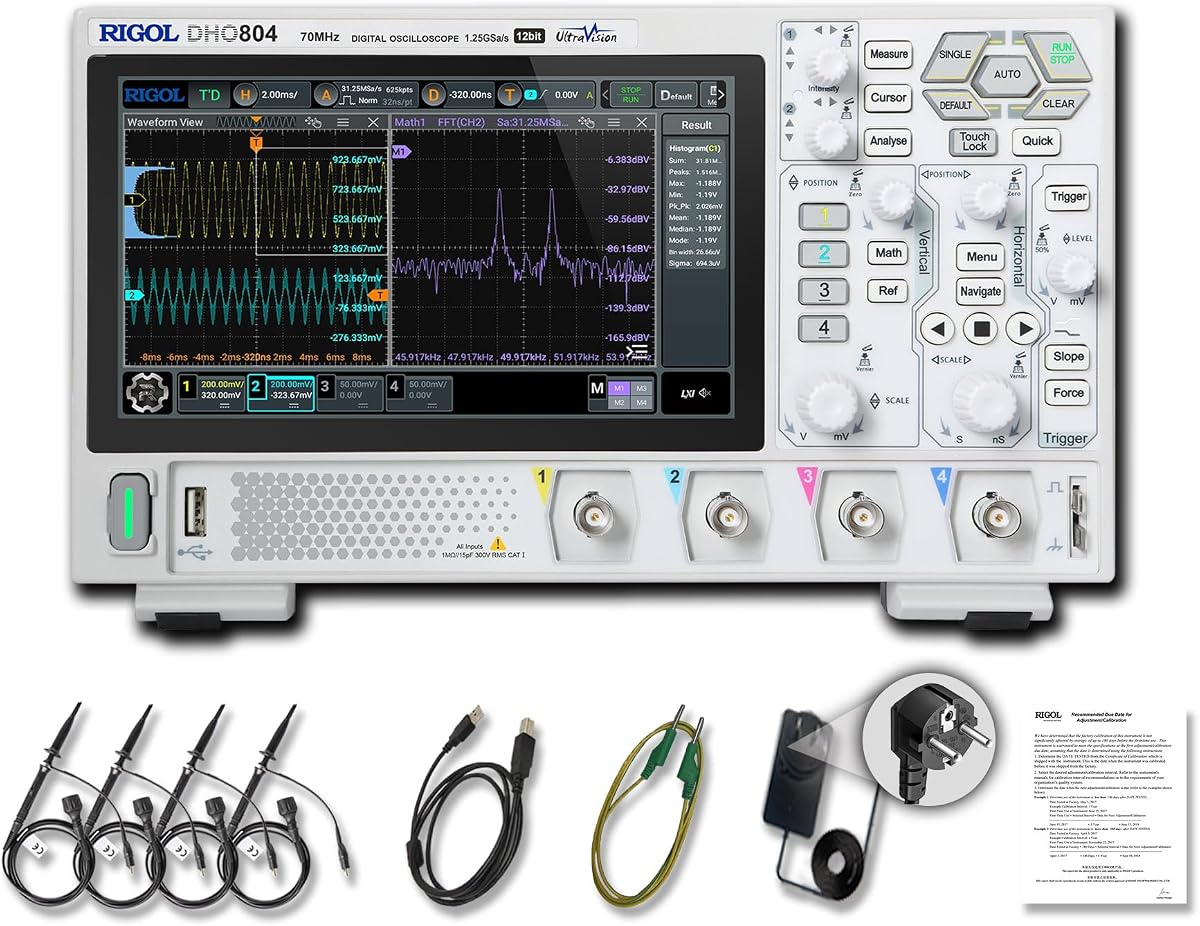
The RIGOL DHO804 stands out as a top contender for engineers needing high resolution at a portable form factor. It offers 12-bit vertical resolution, which provides significantly more vertical detail compared to standard 8-bit scopes. This makes it ideal for analyzing power supply ripple and noise where small voltage changes matter.
We may earn a commission when you buy through this link, at no additional cost to you.
Its UltraAcquire technology captures up to 1,000,000 waveforms per second, ensuring you do not miss rare glitches during switching power analysis. The 256-level intensity grading helps visualize signal density over time. Additionally, the built-in FFT and serial decode support for CAN, RS232, and SPI streamline embedded system debugging without extra hardware.
While the 70 MHz bandwidth limits high-frequency RF work, the four channels allow for comprehensive rail correlation. The 7-inch touchscreen and Flex Knob improve daily productivity by making navigation intuitive. Users may find the memory depth adequate but not infinite for very long acquisitions compared to higher-end benchtop units.
This device is best for power electronics engineers and embedded developers who prioritize vertical resolution and protocol decoding. The combination of portability and advanced features makes it a versatile lab instrument. We recommend it for those needing precise signal integrity checks in a compact package.
The 12-bit resolution allows you to distinguish tiny voltage differences that standard scopes might smooth over, crucial for noise analysis.
Integrated serial trigger and decode features save time by automatically parsing data on common bus lines directly on the display.
We may earn a commission when you buy through this link, at no additional cost to you.
The RIGOL DHO924S elevates the DHO series with double the bandwidth and significant memory depth improvements. At 250 MHz, it handles faster edges and high-speed embedded timing with ease. The S model includes a built-in signal generator and Bode plot analysis, making it a complete solution for power supply loop response testing.
We may earn a commission when you buy through this link, at no additional cost to you.
With 50 Mpts of memory, you can capture long records without sacrificing sample rate. This is essential for observing rare events that occur over extended periods. The UltraAcquire system continues to deliver high waveform update rates, helping you locate intermittent glitches efficiently. Web control and SCPI commands enable remote automation in lab environments.
One limitation is the requirement for a specific probe to access the 16 digital channels, which adds to the total cost. However, the inclusion of advanced analysis tools like Bode plots justifies the investment for serious engineers. The touchscreen interface remains consistent with the DHO804 for a familiar user experience.
This scope is ideal for professionals working on high-speed digital designs and power electronics validation. The ability to perform loop stability checks directly on the device reduces reliance on external equipment. We recommend it for those needing premium features and higher bandwidth in a portable chassis.
Built-in AFG allows you to stimulate circuits without needing a separate function generator on your bench.
50 Mpts memory depth ensures you can record long events at full sampling rate for detailed offline analysis.
We may earn a commission when you buy through this link, at no additional cost to you.
The FNIRSI DPOS350P offers an impressive 350 MHz bandwidth at a competitive price point. It combines an oscilloscope, spectrum analyzer, frequency response analyzer, and DDS signal generator into one handheld unit. This versatility makes it a strong choice for hobbyists and students needing multiple tools without buying separate devices.
We may earn a commission when you buy through this link, at no additional cost to you.
Its FFT-based analysis extends from 200KHz to 350MHz, allowing for EMI checks and signal integrity analysis. The spectrum analyzer feature includes a real-time 2D/3D waterfall view, which is rare at this price. Additionally, the frequency response analyzer supports loop stability tests for analog filters and power systems.
Trade-offs include a lower memory depth of 47 Kpts compared to RIGOL models, which limits long capture capabilities. It also has only two analog channels, which might be insufficient for complex multi-rail debugging. However, the battery life and portability make it excellent for field work and educational settings.
This device is perfect for electronics enthusiasts and entry-level engineers needing high bandwidth and analysis tools. The integration of multiple instruments into one chassis saves desk space and cost. We recommend it for those who prioritize bandwidth and multifunctionality over deep memory.
Four distinct measurement tools in one device reduce the need for multiple instruments on your workbench.
An 8000 mAh battery and USB-C charging ensure you can take the unit to remote sites without external power.
We may earn a commission when you buy through this link, at no additional cost to you.
The RIGOL DS1102Z-E remains a bestseller due to its exceptional balance of features and affordability. With a 100 MHz bandwidth and 24 Mpts deep memory, it captures fast edges and long records effectively. Its popularity in education and hobbyist labs speaks to its reliability and ease of use.
We may earn a commission when you buy through this link, at no additional cost to you.
The high waveform capture rate of up to 30,000 wfms/s helps reveal intermittent glitches that standard scopes miss. Serial bus decoding for RS232, UART, I2C, and SPI adds significant value for embedded troubleshooting. LAN connectivity allows for remote monitoring and documentation without physical presence.
While it lacks the 12-bit resolution of newer DHO models, its standard 8-bit performance is sufficient for many general applications. The 7-inch WVGA display provides a digital-phosphor style view, though it is not a touchscreen. Users may find the control layout slightly dated compared to modern touch interfaces.
This scope is ideal for students, educators, and general electronics repair work. It offers professional-grade features at an entry-level price. We recommend it for those needing a reliable benchtop instrument without advanced touch controls.
Widely used in educational settings, this model has a track record of stability and support for learning.
24 Mpts memory depth allows for zooming into long time captures without losing detail.
We may earn a commission when you buy through this link, at no additional cost to you.
The FNIRSI 2C53T combines a 50 MHz oscilloscope with a full-featured 4.5-digit multimeter in one device. This dual functionality makes it a convenient tool for field repairs where both signal and voltage measurements are needed. It supports voltage, current, resistance, and capacitance measurements alongside waveform display.
We may earn a commission when you buy through this link, at no additional cost to you.
Its FPGA+MCU+ADC hardware architecture ensures stable performance despite the compact design. The 2.8-inch LCD display is bright enough for close-up work, though it is not as large as benchtop units. Type-C charging and a 3000 mAh battery provide decent autonomy for on-the-go tasks.
The 50 MHz bandwidth limits it to low-frequency digital and analog circuits. It is not suitable for high-speed RF work or complex power electronics. However, for basic hobbyist projects and automotive maintenance, the trade-off is acceptable for the low cost and added multimeter utility.
This device is best for hobbyists and mobile technicians needing a versatile tool in a small package. The integration of a multimeter eliminates the need to carry separate devices. We recommend it for those prioritizing portability and low cost over high bandwidth.
Measuring voltage with a multimeter and viewing waveforms simultaneously saves time during debugging.
A compact form factor and built-in battery make this easy to carry to job sites without external power.
We may earn a commission when you buy through this link, at no additional cost to you.
The FNIRSI DSO152 is one of the most affordable oscilloscopes on the market. It is designed for students and beginners who need to visualize basic analog and digital signals. With a 200 kHz bandwidth and 2.5 MS/s sampling rate, it covers audio frequencies and low-speed logic circuits.
We may earn a commission when you buy through this link, at no additional cost to you.
Its pocket-sized design makes it easy to carry in a toolbox or backpack. The one-key AUTO setting simplifies operation, displaying measured waveforms without complex adjustments. Firmware upgrades via Type-C keep the device updated. The battery supports about four hours of continuous use.
The low bandwidth restricts it from analyzing high-speed data lines or RF signals. It serves best as a learning tool rather than a professional diagnostic device. However, for checking basic power supplies or audio signals, it offers excellent value for money.
This device is perfect for educational settings and hobbyists on a tight budget. It introduces waveform visualization without a significant financial commitment. We recommend it for those needing a basic visualizer for simple circuits.
The auto setup feature allows users to see waveforms immediately without needing deep technical knowledge.
The small footprint fits easily in a pocket, making it ideal for mobile troubleshooting tasks.
We may earn a commission when you buy through this link, at no additional cost to you.
The Hantek DSO2D15 provides a solid mid-range option for labs needing 150 MHz bandwidth. It supports arbitrary waveform output, which is useful for injecting test signals directly. With 14 trigger modes and 5 serial protocol decodes, it covers most standard debugging scenarios without extra cost.
We may earn a commission when you buy through this link, at no additional cost to you.
It is designed as a cost-effective instrument for communication, embedded systems, and education. The package weight is substantial at over 6 pounds, indicating a sturdy build. Standard triggers help isolate specific signal events, improving analysis efficiency in noisy environments.
While it lacks the touchscreen of newer models, its physical controls are reliable. The arbitrary waveform generator adds value for testing custom signal patterns. Users seeking advanced math functions or deep memory may find it limited, but it serves general-purpose lab work well.
This scope is best for technical educators and general electronics labs. It offers a balance of performance and cost for daily use. We recommend it for institutions needing multiple units without high individual cost.
The ability to generate custom test signals adds versatility without needing a separate function generator.
A heavier chassis suggests durability suitable for frequent use in busy laboratory environments.
We may earn a commission when you buy through this link, at no additional cost to you.
The FNIRSI 1013D Plus brings a 7-inch touchscreen to the entry-level 100 MHz segment. This interface allows for intuitive gesture operations and easy cursor measurements without navigating complex menus. The 1 GB storage space can hold over 1000 screenshots and waveform data sets for easy management.
We may earn a commission when you buy through this link, at no additional cost to you.
It features Lissajous graphic display for phase and frequency comparison, which is useful for RF and oscillator tuning. The device is thin and lightweight, with a high-voltage protection module that tolerates continuous voltage up to 400 V. A 6000 mAh battery supports about four hours of use.
Users may find the touchscreen less responsive than benchtop units in some conditions. While 100 MHz covers most hobbyist needs, high-speed work requires more. However, the visual interface makes it a modern choice for those uncomfortable with physical knobs.
This device is ideal for modern hobbyists and students preferring touch controls. The storage and display features enhance the user experience. We recommend it for those who prioritize interface usability in a budget scope.
Touch gestures allow for quick zooming and navigating waveforms without learning complex button combinations.
1 GB internal storage ensures you can archive many projects without needing external drives frequently.
We may earn a commission when you buy through this link, at no additional cost to you.
Generic options often provide basic functionality for users with minimal needs. They typically include standard oscilloscope features like waveform display and basic measurement. These units serve as entry points for those testing the technology before investing in branded models.
We may earn a commission when you buy through this link, at no additional cost to you.
Specifications are often minimal, focusing on core voltage and frequency visualization. They lack advanced protocol decoding or high memory depth found in named brands. While cost-effective, they may not offer the reliability or support of established manufacturers.
Users may find these units sufficient for simple educational demos. However, professional work requires better performance. The value lies purely in low cost for very basic applications.
This category is best for absolute beginners needing a low-risk introduction to oscilloscopes. We recommend it only for very low-budget projects with minimal performance needs.
These units provide fundamental waveform viewing capabilities without advanced features.
They offer a minimal financial entry point for those exploring electronics basics.
We may earn a commission when you buy through this link, at no additional cost to you.
Similar to the first generic option, this alternative offers basic waveform visualization. It targets users needing a simple tool without complex menus. These devices often serve as backup units for light monitoring tasks.
We may earn a commission when you buy through this link, at no additional cost to you.
Advanced features like FFT or deep memory are typically absent. The build quality varies, so checking reviews is crucial. They represent a riskier investment due to limited support or warranty compared to branded products.
While the price is low, the trade-offs in performance are significant. They may not sustain regular lab use over time. Consider them only for occasional non-critical measurements.
This option is best for temporary projects with strict budget constraints. We recommend prioritizing branded models for any serious work.
These devices focus on core display capabilities without extensive analysis features.
They provide another pathway for those seeking the lowest possible price for basic viewing.
We may earn a commission when you buy through this link, at no additional cost to you.
Selecting the right digital oscilloscope requires understanding your measurement needs and technical constraints.
Bandwidth determines the maximum frequency the scope can accurately measure. For most hobbyist and embedded work, 100 MHz is sufficient. Higher bandwidth is needed for RF and high-speed digital signals.
Choose a bandwidth at least five times the fastest signal frequency you plan to measure.
Sampling rate indicates how many data points the scope captures per second. A higher rate ensures detailed waveforms and accurate timing measurements. Look for at least 5 GS/s for professional use.
Ensure the sample rate is at least four times the bandwidth for accurate signal reconstruction.
Memory depth affects how much signal data the scope can store. More memory allows longer captures without losing sample rate. This is critical for debugging intermittent glitches over time.
Opt for deep memory like 24 Mpts or more if you need long duration analysis.
Channels determine how many signals you can view simultaneously. Two channels are standard, but four allow for full system debugging. Consider future needs before committing to fewer channels.
Four channels provide better visibility for multi-rail power systems.
Handheld scopes are lightweight and battery-powered for field work. Benchtop models are heavier but offer more connectivity. Decide where you will use the device most often.
Choose handheld for field repairs and benchtop for lab environments.
Connectivity options like USB, LAN, and HDMI enable data export and remote control. SCPI commands support automation. Web control allows remote access without software installation.
LAN and USB are essential for integration into automated test systems.
Screen size and resolution impact readability. Touchscreens simplify navigation, while physical knobs provide tactile control. High contrast helps in dim environments.
Prioritize high-resolution displays for precise measurements.
Serial decoding support for I2C, SPI, and CAN speeds up debugging. It translates raw binary data into readable formats. This eliminates manual data analysis steps.
Check for protocols relevant to your specific system designs.
Always calibrate the probes before taking measurements to ensure accuracy. Connect the ground clip securely to the circuit ground to avoid noise.
Adjust the vertical scale to fit the waveform within the grid. Use horizontal time base settings to view the details of your signal cycle.
Store the device in a dry, cool place. Protect the screen from scratches and ensure the battery is charged before storage to prevent cell degradation.
Higher resolution like 12-bit provides more vertical steps to distinguish small voltage changes. This is crucial for measuring power supply ripple where noise is tiny. 8-bit scopes are sufficient for larger signal variations.
Deep memory allows you to capture longer periods of time without reducing sample rate. This helps in finding rare glitches that happen infrequently. Standard memory might skip details over long durations.
Yes, most scopes with 50 MHz or higher bandwidth cover audio frequencies easily. Audio signals typically range from 20 Hz to 20 kHz. You can visualize distortion and waveforms in this range.
Look for a built-in battery, USB-C charging, and light weight. Screen visibility in bright environments is also important for field work. Ensure it meets your bandwidth requirements despite size.
Select the serial decode function and choose the protocol type like I2C or UART. Connect the scope probe to the data line and ground. The scope will overlay decoded data on the waveform.
Touchscreens offer faster navigation and direct parameter adjustments. Buttons provide tactile feedback which some users prefer for quick changes. Many units combine both for flexibility.
Digital logic probes often require specific interfaces to handle voltage levels safely. Ensure your scope supports the probe type needed for digital decoding. Compatibility is key for accurate logic analysis.
It allows you to inject test signals into a circuit without external equipment. This is useful for frequency response testing and calibration. It reduces the need for separate function generators.
We have reviewed ten distinct digital oscilloscope models ranging from handheld to benchtop. The RIGOL DHO804 stands out for high resolution, while the FNIRSI DSO152 offers budget-friendly portability.
Prioritize bandwidth and channel count based on your specific projects. High-resolution units are valuable for power electronics, while standard 8-bit scopes suffice for general hobbyist use.
Prices may vary, so always verify current listings before purchase. We hope this guide helps you select the perfect tool for your signal analysis needs.