
SUNLU Filament Dryer Box 2026 New Upgrade S1 Plus
4.3Editor score
Built-in fan for faster drying
LCD screen for humidity monitoring
Fits multiple filament types
This guide compares the top filament dryer for 3D printing models to help you choose the best moisture control solution for your printing needs.
Filament dryers are essential tools for maintaining high-quality 3D prints by removing moisture that causes stringing and clogging. Choosing the right dryer ensures consistent results across various materials like PLA, ABS, and Nylon without damaging your printer.
We evaluated ten leading models based on heating efficiency, capacity, temperature control, and sealing technology. Our analysis focuses on real-world performance, ease of use, and compatibility with standard spool sizes to provide a reliable comparison for makers.
Each selection highlights unique strengths such as dual chambers, smart sensors, or large storage options. Note that pricing fluctuates frequently so always check current listings before purchasing to secure the best deal available today.
4.3Editor score

4.6Editor score

4.5Editor score
The following table provides a side-by-side look at key specifications for each model to help you quickly identify the right fit for your workflow.



The Creality Space Pi X4 stands out as a top-tier solution for serious makers needing efficient moisture control. With a rating of 4.6 stars users praise its dual heating chambers that dry filament 30% faster than single-unit dryers.
We may earn a commission when you buy through this link, at no additional cost to you.
Its dual 200W heating chambers reach up to 85°C which unlocks drying for advanced materials like ABS and PC. The illuminated window lets you check spools without breaking the sealed environment maintaining humidity control during printing pauses.
While effective the unit is physically large and may not fit on smaller workspaces. Additionally the premium price tag reflects its advanced features which might be overkill for casual users with limited filament types.
We recommend this for professionals or enthusiasts who print multiple spools regularly. It ensures consistent quality by eliminating moisture-related failures while offering ample storage to keep your library organized and dry.
Independent heating zones allow faster moisture removal across multiple spools simultaneously.
Higher temperature capability supports engineering-grade filaments that require more aggressive drying.
We may earn a commission when you buy through this link, at no additional cost to you.
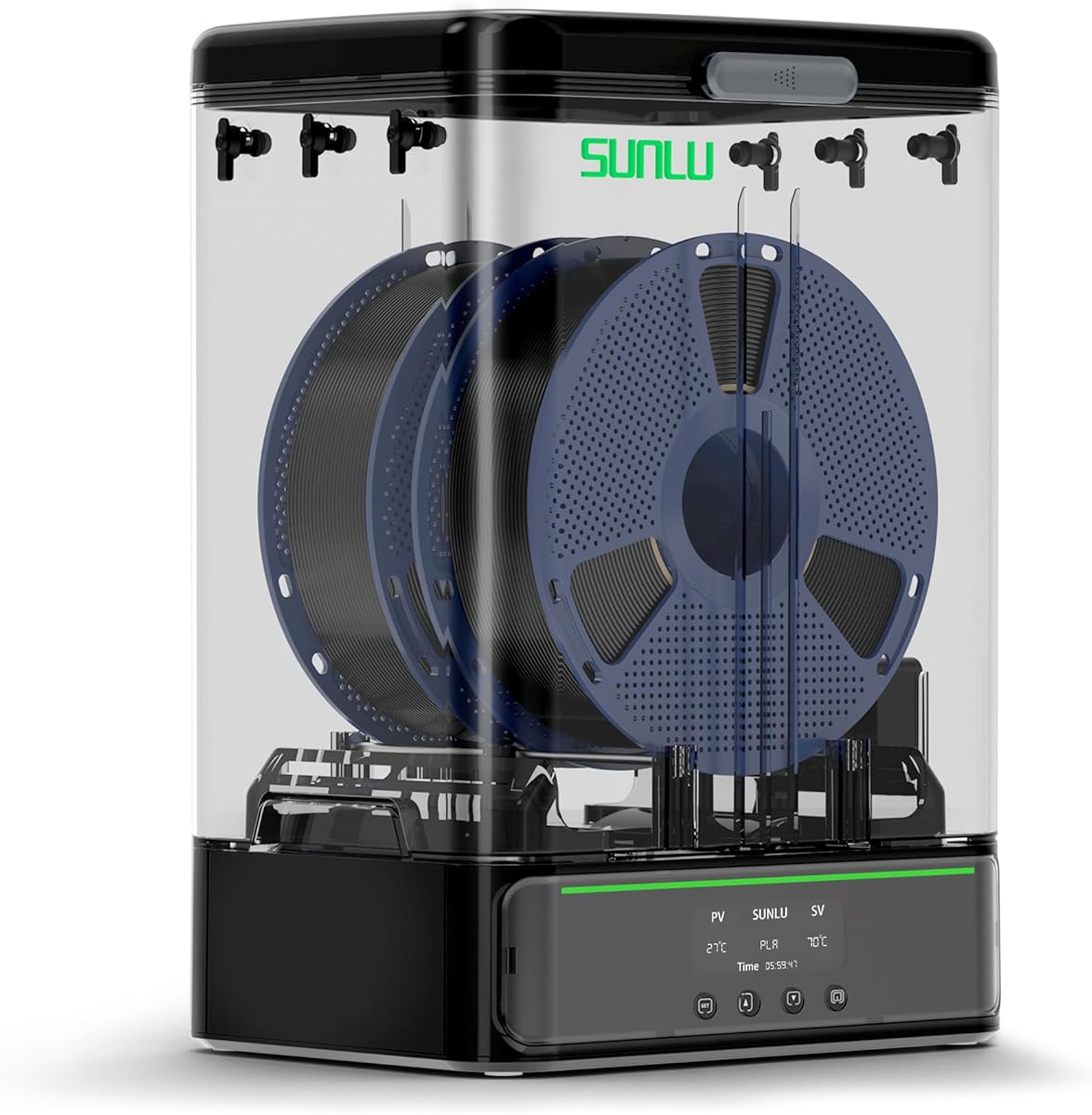
The SUNLU S1 Plus offers exceptional value for those new to filament drying. With a 4.3 rating users highlight its upgraded fan design that speeds up moisture discharge compared to passive heating units.
We may earn a commission when you buy through this link, at no additional cost to you.
Its adjustable range up to 55°C covers most common filaments like PLA and PETG effectively. The 2-inch LCD screen clearly displays temperature and humidity allowing easy monitoring without guesswork.
Some users note the build quality is lightweight which may affect long-term durability. Also single-chamber drying takes longer for multiple spools compared to dual-heater models.
This is the ideal pick for hobbyists on a budget needing reliable drying for daily prints. It simplifies moisture management without breaking the bank.
The added fan circulates hot air for more uniform drying across the spool.
The LCD provides real-time feedback for precise adjustment of drying parameters.
We may earn a commission when you buy through this link, at no additional cost to you.
The SUNLU S4 delivers top-tier performance for complex printing environments. A 4.5 rating reflects its robust 350W PTC heater that ensures rapid even drying across four spools.
We may earn a commission when you buy through this link, at no additional cost to you.
Eight filament exit holes allow feeding multiple printers simultaneously. This makes it perfect for farms or workshops with several machines running different materials at once.
The unit is heavy at 4KG which may limit portability. Setup involves managing multiple tubes which could challenge users seeking simplicity.
Ideal for power users needing high throughput and flexibility. It supports a wide range of materials ensuring your entire fleet stays dry.
Multiple outlets enable simultaneous drying and feeding for several machines.
Strong heating element reduces wait time for filament readiness.
We may earn a commission when you buy through this link, at no additional cost to you.
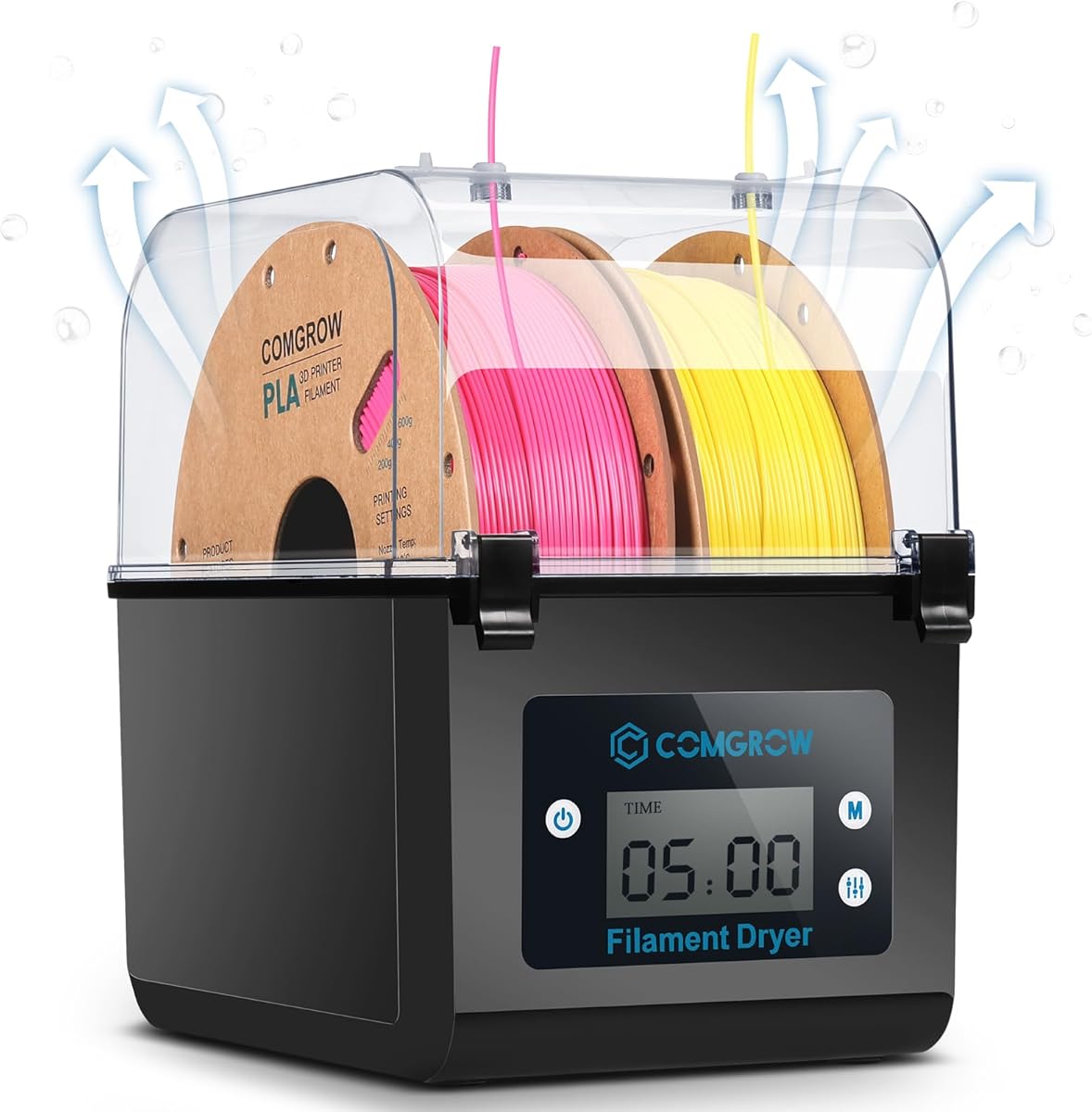
Comgrow offers a straightforward box for keeping filaments dry during prints. Rated 4.4 stars it focuses on essential sealing and basic temperature control for common materials.
We may earn a commission when you buy through this link, at no additional cost to you.
The silicone cable sheath provides a good seal to prevent moisture reentry. It fits 2kg spools which is sufficient for standard home usage.
Limited to 50°C this unit struggles with high-temp materials like Nylon. Capacity restricts it to minimal storage needs.
Best for users prioritizing simplicity over advanced features. It keeps spools accessible while reducing moisture issues.
Silicone sheath maintains dry environment during active printing.
Touch buttons allow simple setting of time and temperature.
We may earn a commission when you buy through this link, at no additional cost to you.
Creality introduces smart presets for easy operation. With a 4.4 rating users like selecting from 12 filament types directly without manual tuning.
We may earn a commission when you buy through this link, at no additional cost to you.
The 3.7-inch touch screen offers an intuitive interface. Hot-air circulation ensures uniform heating across both spools.
It handles two spools which is less than larger units. Heater power is moderate compared to high-wattage competitors.
Ideal for those who value convenience over speed. It simplifies drying for common materials effectively.
Presets remove guesswork for common filament drying requirements.
Touch screen provides easy navigation and clear information.
We may earn a commission when you buy through this link, at no additional cost to you.
Polymaker focuses on holistic moisture control with integrated desiccants. Rated 4.3 users appreciate the seamless transition from drying to storage.
We may earn a commission when you buy through this link, at no additional cost to you.
The built-in hygrometer helps track humidity levels actively. It supports a wide range of materials including Nylon.
Heating may be less aggressive than dedicated dryers. Internal space is limited for large spools.
Best for those needing comprehensive protection beyond heating. It ensures filament stays ready for long periods.
Combines heat and desiccants for maximum moisture elimination.
Hygrometer gives clear data on storage conditions.
We may earn a commission when you buy through this link, at no additional cost to you.
This model prioritizes plug-and-play functionality. Rated 4.3 users value its quick heat-up and simple knob controls.
We may earn a commission when you buy through this link, at no additional cost to you.
Thermal insulation helps maintain internal heat. The countdown timer tracks progress clearly.
Capacity is limited to one spool. Manual knobs lack digital precision.
Best for users needing a no-fuss solution. It provides reliable results with minimal effort.
Cotton lining retains heat for better energy use.
Countdown display keeps you informed of drying status.
We may earn a commission when you buy through this link, at no additional cost to you.
An updated version of the S4 offering robust performance. Rated 4.6 users praise its even drying via three circulation fans.
We may earn a commission when you buy through this link, at no additional cost to you.
Large internal space accommodates multiple spools. The 350W heater ensures rapid moisture removal.
Physical size requires significant workspace. Setup involves tube management.
Best for high-volume printers needing capacity. It delivers consistent results across multiple materials.
Multiple fans prevent cold spots within the chamber.
Fits up to four spools for extended printing runs.
We may earn a commission when you buy through this link, at no additional cost to you.
The SP2 is designed for heavy-duty rolls. Rated 4.4 users appreciate its ability to handle 3kg spools directly.
We may earn a commission when you buy through this link, at no additional cost to you.
It heats to 70°C in 15 minutes efficiently. The detachable base allows it to double as storage.
Limited to one spool at a time. Tube options may restrict printing angles.
Ideal for industrial settings using large rolls. It combines drying and storage in one unit.
Rollers accommodate heavier and larger diameter spools.
Rapid heat-up gets filament ready for printing quickly.
We may earn a commission when you buy through this link, at no additional cost to you.
A compact and simple dryer for starters. Rated 4.3 users find it easy to operate and check spools.
We may earn a commission when you buy through this link, at no additional cost to you.
The spinner ensures filament rotates for uniform drying. Translucent lid allows visual checks.
Basic interface lacks advanced controls. Limited space restricts to single spool.
Best for entry-level users needing simplicity. It effectively mitigates moisture for small prints.
Continuous rotation prevents moisture buildup in one spot.
Clear lid lets you see progress without opening.
We may earn a commission when you buy through this link, at no additional cost to you.
Selecting the right dryer involves balancing capacity, temperature, and features to match your workflow. Here are the key factors to consider.
Capacity determines how many spools you can dry at once. Home users may need only two while professionals benefit from four or more to keep multiple machines fed. Measure your workspace to ensure the unit fits comfortably.
Different materials require specific drying temperatures. PLA needs lower heat around 50°C while ABS or Nylon may need 80°C. Ensure the dryer supports the highest temp your materials need to avoid ineffective drying.
PTC heaters offer safety and efficiency compared to standard heating pads. Look for models with fans for better air circulation which prevents hot spots. This ensures even moisture removal across the entire spool surface.
Effective seals prevent ambient humidity from reentering the chamber. Rubber gaskets or silicone sheaths are ideal. A tight seal is crucial for maintaining dry conditions during pauses or storage after drying.
Modern interfaces include touch screens or digital displays for precision. Timers help automate the drying process so you don't need to monitor constantly. Presets can simplify selection for specific filament types.
Ensure the dryer handles your specific spool weights and diameters. Larger 3kg rolls may need specialized supports. Check compatibility with 1.75mm and 2.85mm filaments to avoid loading issues.
Higher wattage means faster heating but also more energy use. Balance speed with your electricity costs. Units with insulation help reduce power consumption by retaining heat better during cycles.
Look for extras like humidity monitors or storage bases. These add value by offering a complete solution for filament care. Consider warranty and support options for long-term reliability.
Begin by placing the spool on the roller or holder inside the chamber. Ensure the filament end is threaded through the outlet tube correctly to prevent tangles during printing.
Set the temperature and time based on your filament type. Start with manufacturer recommended settings if available. Monitor the process occasionally using the display to ensure stability.
After drying close the outlet tube or seal the chamber to maintain low humidity. Regularly clean the interior of dust and check gaskets for wear to ensure continued performance.
Frequency depends on your local humidity and how often you use each spool. If your prints show stringing or bubbles drying for a few hours before use is ideal. For humid environments pre-drying may be needed weekly.
Most dryers allow storage when powered off but sealing is key. Use the integrated seals or transfer spools to airtight bags after drying to prevent reabsorption of moisture while stored.
Proper drying does not affect diameter but excessive heat can warp it. Stay within recommended temperature ranges to ensure dimensional accuracy remains intact for precise printing.
A mild odor is normal as moisture evaporates. Strong chemical smells may indicate overheating or material degradation. Reduce temperature immediately and check ventilation around the unit.
Most dryers work with any standard FDM printer as long as filament can feed smoothly. Ensure the outlet tube aligns with your printer's extruder to prevent tension or jamming.
Drying times vary by material but typically range from 4 to 8 hours. PLA may dry faster while Nylon could take longer. Always check manufacturer guidelines for specific materials.
It is best to dry materials with similar temperature requirements together. Mixing high and low temp materials may lead to under-drying or overheating. Group PLA separately from Nylon or ABS.
Clean the interior occasionally and inspect seals for debris. Check outlet tubes for blockages and replace if worn. Ensure vents are clear for proper airflow during operation.
Choosing the right dryer significantly improves print reliability. Models like the Creality X4 and SUNLU S4 offer power for advanced users while options like the SUNLU S1 Plus provide affordability for beginners.
Prioritize temperature range and capacity to match your material needs. A dryer with good sealing and smart controls adds long-term value to your setup.
Always verify current prices and availability as deals fluctuate. Investing in quality moisture control ensures your filament stays ready for success.